

Countdown to Halloween - The Old Language of the Earth
Learning to listen again in a noisy world

“The scent of rosemary, the smoke of sage, the whisper of bay, the old language of the earth still speaks if we pause long enough to listen.”
— Beth Schreibman Gehring, from Forage & Gather
There is a language older than words. It doesn’t live on a page, and it doesn’t ask to be translated. You can’t learn it by reading; you remember it by feeling. It’s the language of the earth itself, spoken in the low hum of bees, the sigh of the wind through drying herbs, the curl of woodsmoke that threads its way into your hair at dusk.
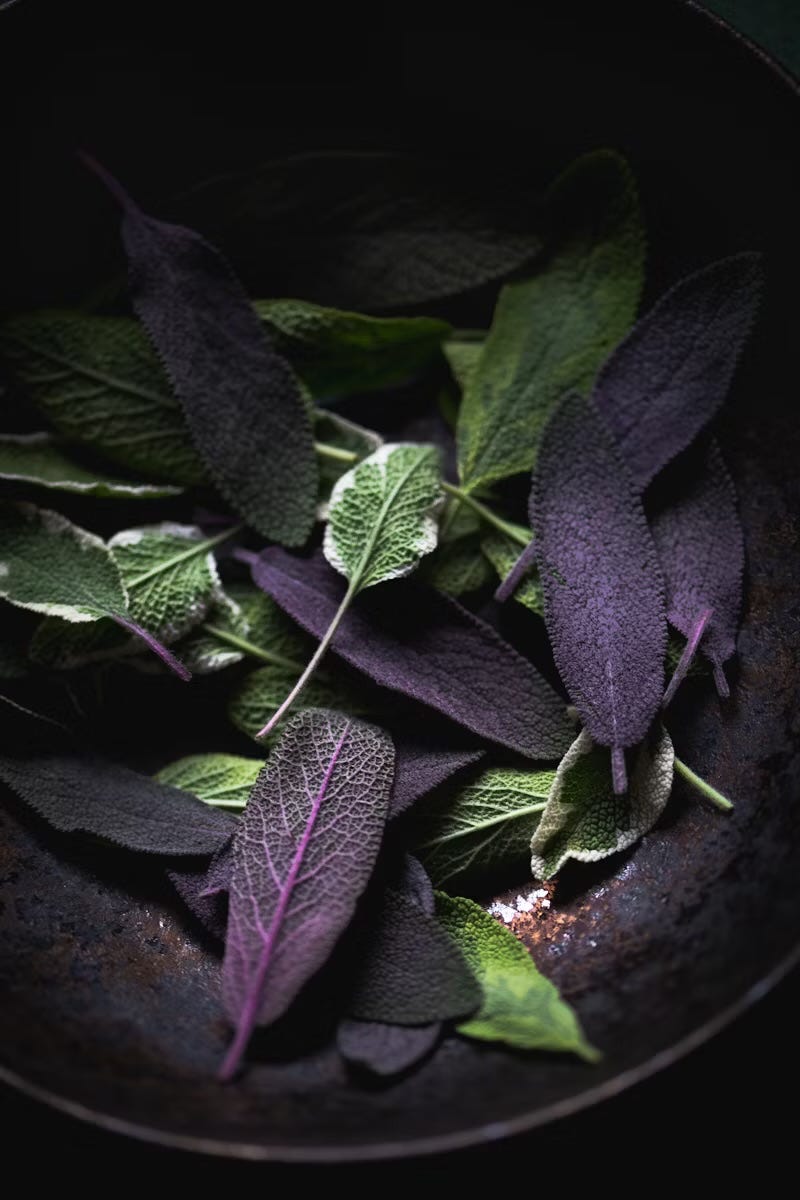
I think of this language most when I’m standing in my garden with my hands full of green things. Rosemary, sage, bay, the trinity of scent that seems to open some ancient door in the heart. Each one carries memory. Rosemary for remembrance, sage for cleansing, bay for protection and courage. Their perfume is both domestic and sacred, the same whether you find it in a kitchen or a temple. When their oils rise in the warmth of your palms, it’s as if the earth itself is speaking again.
To listen, you have to slow down. You have to let the noise of the modern world fade until you can hear the soft, steady pulse beneath it, the breath of the soil, the rustle of roots. When I light a small bundle of sage or tuck rosemary into the edges of a simmering pot, I’m not performing a ritual so much as answering a conversation. The herbs speak of the places they’ve grown, of sun and water and the invisible choreography of the seasons. They remind me that everything is alive in relation to everything else.
This is especially true now, as the light shifts and the days grow short, when the world feels as though it’s turning inward to breathe. The air sharpens, the nights deepen, and the veil between what is seen and unseen grows thin. It’s a different kind of listening — quieter, closer, edged with memory. You can feel it in the whisper of dry leaves underfoot, in the scent of smoke, in the way dusk comes so early it feels almost alive. This is the time of Samhain, when we honor what’s passed, what lingers, and what waits just beyond our ordinary senses.
Long before we had recipes or calendars, people read the world this way. They knew what the first frost would taste like in the air, or when to harvest a plant by the tilt of its leaves. They understood that scent wasn’t just pleasure; it was information, protection, communion. To walk through a kitchen garden was to move through a kind of library, each plant a word in a living vocabulary of care.
That old language never vanished. It only waits for us to quiet ourselves enough to hear it again. You can catch it in the morning, when dew gathers on mint leaves and the air smells green and wet. You can hear it in the creak of a tree in winter, in the murmur of bees, in the way the wind moves through drying stems of lavender. You can even hear it in your own breathing when you realize you are part of that conversation, not outside it.
Every act of tending — pruning, watering, planting — is a sentence in that dialogue. Every simmerpot, every herbal bundle, every loaf of bread kneaded with fragrant hands is a translation. The earth still speaks. Our task is to remember how to listen.
If you want to begin, start small. Choose one herb that calls to you — rosemary, mint, or thyme — and spend a moment each day with it. Crush a leaf between your fingers, breathe it in, and let the scent tell you something about where it has been. Notice the texture, the sound of the breeze moving through it, the way it changes in the light.
And then, widen your listening. Watch the world as it prepares for rest. Watch the dogs as they linger longer by the fire or curl beside you as the evenings cool. Notice the cats finding their favorite sunlit corners, the hens settling earlier in their straw, the horses growing new coats, glossy and thick against the coming cold. Watch the squirrels stashing acorns with wild devotion, and the water in the lakes and streams deepening in color, slowing with the chill. Pay attention to the light as it softens from gold to pewter, the long shadows stretching like an old song across the fields.
This is the listening that belongs to autumn’s waning. It’s the same listening that allows us to sense the thin places — those moments when something ancient stirs just beyond the edge of what we can explain. Some call it intuition, others remembrance, but I think it’s the earth herself reminding us that we’re still part of the mystery.
In the middle of our daily lives, surrounded by technology and constant connection, by the endless scroll and hum of distraction, this may be the healthiest thing we can do for ourselves: to unplug for a while and step back into the living world. To walk outside without a camera or a purpose, to listen not for news but for wind, for wings, for the simple pulse of life continuing without us.
I find that when I give myself that kind of space, the world grows large again. The ordinary things — bread rising on the counter, the sound of a kettle, the smell of rosemary on my hands — become sacred. This is the same knowing that hums beneath Samhain’s quiet threshold, where endings and beginnings meet in a single breath. It’s not about ghosts or spirits so much as presence — the way the past and present touch, the way we are never truly alone when we listen.
This, too, is language. This is the grammar of the turning year, the earth’s steady heartbeat beneath all our busy noise. The more we listen, the more fluent we become in this ancient conversation, until even silence begins to speak.

A Note from the Hearth
As we move toward Samhain and the long hush of winter, I hope you’ll find a moment to listen in your own way. Step outside in the early evening and let the air rest on your skin. Notice what’s changed since last week — the sound of the leaves, the slant of light, the faint woodsmoke that always seems to carry memory with it.
You don’t have to live on a farm or deep in the woods to hear the old language. It’s in the wind that moves through city trees, in the call of crows at dusk, in the warmth of your dog curled at your feet. The world is still speaking, softly but constantly, if we’re willing to meet it halfway.
I’d love to hear how you’re listening this season — what you’re noticing, what’s stirring, what’s quietly shifting in your corner of the world. You can reply to this letter and tell me; I read every note.
May this season bring you stillness, warmth, and wonder.
Beth
This space remains free because it’s meant to be shared. If you believe in that, you can support it by becoming a paid subscriber. Paid subscribers keep the lights on—quite literally—but the stories, recipes, and field notes stay open to all. Every so often, I send a private letter to say thank you and share what’s brewing behind the scenes.
Today in the Washington Post, Dana Milbank has an article on "forest bathing" ("Shinrin-yoku", as the Japanese call it). He went into the woods with a bunch of doctors from Harvard to not just try it out, but to learn about recent investigations of the benefits. Seems that just being out in nature, and imagining yourself physically connecting to it, might actually do some real good to physical and mental health.